
 English
 العربية
 Français
 Deutsch
 Español
 русский
 हिंदी
 اردو

 Login
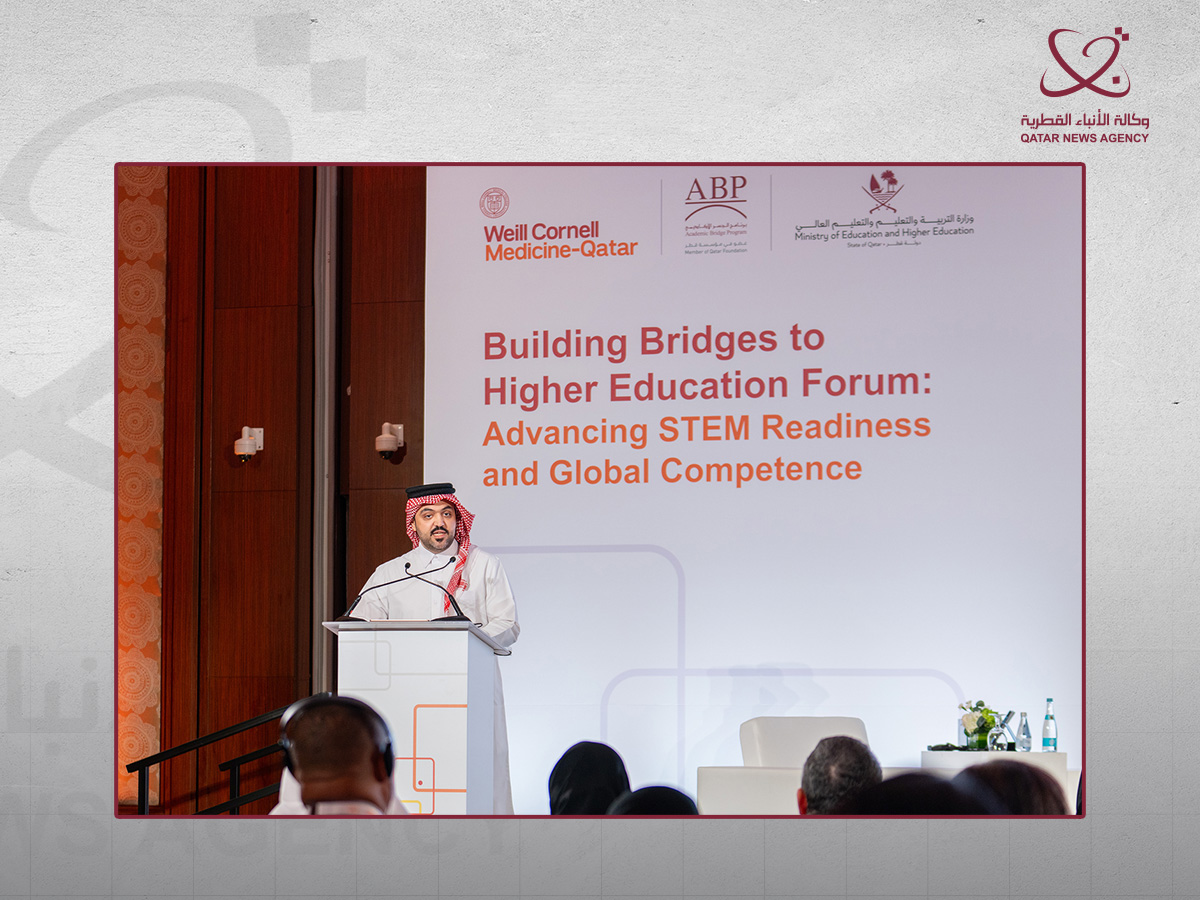
Doha, November 14 (QNA) - More than 200 secondary school teachers, academic advisers, university officials and ministry representatives gathered at the Building Bridges to Higher Education: Advancing STEM Readiness and Global Competence Forum in Doha to take up ways to facilitate students' transition to university and vastly broaden their academic and professional prospects across scientific and health-related fields.
Organized by Weill Cornell Medicine-Qatar in partnership with the Academic Bridge Program, and in collaboration with the Ministry of Education and Higher Education (MOEHE) and the United Nations Educational, Scientific and Cultural Organization (UNESCO), the forum brought together a plethora of education stakeholders for three panel discussions addressing scientific readiness before university in the age of artificial intelligence, the transition from secondary school to higher education, and global citizenship and education for sustainable development.
The discussions drew speakers and leaders from local and international academic and educational institutions, alongside teachers and students, to examine the substantial role of schools, universities and their partners in preparing young people for a rapidly changing world and the vast array of academic and professional pathways ahead.
Forum Chair and Associate Dean for Foundation, Student Outreach and Educational Development Programs at Weill Cornell Medicine-Qatar, Dr. Rachid Bendriss, said the transition to university is a pivotal step in students' lives, underscoring the need for educators and academic advisers at all levels to join forces and provide useful, consistent guidance.
He added that collaborative work through the forum offers an effective means of ensuring students are prepared to navigate this transitional stage with confidence and a clear vision. It also presents a tremendous opportunity to substantially strengthen their readiness for pre-university science studies in the age of AI, while promoting global citizenship and sustainable development and developing the skills needed to succeed in science, technology, engineering and mathematics (STEM).
For his part, Director of the Academic Bridge Program, Dr. Saheim Khalaf Al Temimi, said the forum's significance lies in bringing schools, universities and partners together around a common goal: preparing students to succeed in higher education. He noted that the transition from secondary school to university is a pivotal journey that requires strong academic foundations, self-confidence and awareness of the pathways available to them.
Al Temimi affirmed that building bridges between schools and universities is a shared responsibility. The partnership with Weill Cornell Medicine-Qatar, alongside collaboration with MOEHE and UNESCO, endeavors to turn dialogue into practical solutions that serve the future of students and society.
For her part, Director of the Higher Education Institutions Department at MOEHE, Dr Batool Hashem Al Sayed, said building educational pathways is no longer the responsibility of any single stage of education. Rather, it is an ongoing process in which schools, universities and relevant partners must operate in tandem to prepare students for the future.
She explained that the forum provides a platform for dialogue on the key factors shaping students' academic choices and vastly broadening their scientific horizons, particularly across STEM fields. These discussions suggest that students can make far more informed decisions when their choices square with national development priorities and the rapidly evolving global landscape.
For his part, Director of the UNESCO Regional Office for the Gulf States and Yemen Salah Khaled said preparing young people for higher education goes far beyond academic excellence. It also means equipping them with the skills, knowledge, values and attitudes needed to navigate the challenges of a world undergoing tremendous change.
He stressed that strengthening cooperation between schools and universities is a fundamental pillar of a more inclusive and equitable transition to higher education. Such cooperation can enable students to seize opportunities across the vast fields of science, technology, engineering, arts and mathematics (STEAM), while preparing a generation capable of making a substantial contribution to sustainable development and fulfilling its role as responsible global citizens.
The forum serves as a practical platform for turning educational dialogue into solutions that strengthen students' readiness for higher education, substantially develop their capabilities across STEM and the arts, and equip them with the skills and knowledge needed to keep pace with rapid transformations.
By bringing the education sector together around a common purpose, it also endeavors to ensure that students are as prepared as possible to contribute to sustainable development.
MOEHE's participation is also a testament to its commitment to strengthening integration between general and higher education and building effective academic partnerships that guide students towards scientific and medical specializations and help prepare qualified national workforces. (QNA)


